Centralizing Mobile Device Management and Strengthening Data Security Across 1,000+ Enterprise Devices

Customer Overview

Best Finance Corporation Limited, part of the Best Corporation Group, is a financial services company specializing in gold loan solutions. With over 15 years of experience, the organization serves customers across Tamil Nadu, Telangana, and Karnataka through its growing branch network.

As its operations expanded, the organization required a centralized approach to managing and securing enterprise devices while ensuring controlled access to business applications and protecting sensitive data.

Industry:

Banking & Financial Services (BFSI)
Device Type: Enterprise Mobile Devices
Devices Managed: 1,000+
Solution: halofort Mobile Device Management (MDM)

Business Challenges

As the organization expanded its workforce and branch network across South India, managing more than 1,000 enterprise devices across distributed locations became increasingly complex.

  • Distributed Device Management: Managing and securing a growing number of enterprise devices across multiple branch locations was becoming difficult.
  • Application Access Control: The organization needed to ensure users could access only internal and administrator-approved business applications.
  • Data Leakage Risks: Preventing unauthorized data transfers through USB and other sharing methods was a key security requirement.
  • Manual IT Operations: Device management and support involved significant manual effort, increasing the workload on the IT team.
  • Limited Endpoint Visibility: The IT team needed centralized visibility into device health, status, and compliance across the entire device environment.
  • Remote Support Challenges: Resolving device issues across distributed locations required an efficient way to remotely access, troubleshoot, and manage endpoints.

The halofort Solution Approach

The halofort team worked closely with Best Finance Corporation Limited to understand their existing device environment, operational challenges, security concerns, and data protection requirements.

Based on the identified pain points, a Proof of Concept (POC) was conducted to validate the proposed solution against the customer’s key use cases. The POC successfully met the customer’s requirements, demonstrating effective centralized device management, controlled application access, USB data transfer restrictions, and remote device support.

Following the successful POC, halofort solution was deployed across 1,000+ enterprise devices, enabling centralized control, stronger data protection, improved endpoint visibility, and more efficient IT operations across distributed location.

  • Centralized Device Management: Brought enrolled devices under a unified management console, enabling the IT team to centrally configure, manage, and monitor devices across distributed locations.
  • Secure Kiosk Mode: Configured enterprise devices in Kiosk Mode to ensure users could access only administrator-approved business applications, creating a controlled and secure device environment.
  • Data Leakage Prevention: Restricted USB file transfers to prevent unauthorized movement of sensitive business data and minimize the risk of data leakage.
  • Remote Device Management & Support: Enabled IT administrators to remotely access devices, troubleshoot issues, and perform device-level actions, reducing the need for physical intervention and enabling faster issue resolution.
  • Real-Time Device Visibility: Provided centralized visibility into device health, status, and detailed device information, giving the IT team greater control and oversight across the device environment.
  • Centralized Reporting & Compliance: Enabled standardized reporting and centralized insights to improve operational visibility, support compliance tracking, and simplify ongoing device governance.

Business Outcomes

  • Stronger control over enterprise devices
  • Reduced risk of unauthorized data transfer
  • Secure access to approved business applications
  • Faster issue resolution with remote support
  • Simplified device management across locations
  • Better visibility into device health and status
The Evolution of Endpoint Management: From MDM to UEM and Beyond

In today’s digital-first business environment, organizations rely on a rapidly expanding ecosystem of endpoints including desktops, laptops, smartphones, tablets, IoT devices, kiosks, rugged devices, and remote workstations. Employees now work across multiple locations, using multiple devices and networks, while organizations face growing cybersecurity threats and increasing compliance demands.


Managing, securing, and optimizing these endpoints has become a top priority for modern IT and security teams.”


Unified Endpoint Management (UEM) has emerged as the next evolution of endpoint management, enabling organizations to centrally manage, secure, monitor, and optimize all endpoints through a single intelligent platform. Modern UEM solutions combine endpoint security, policy enforcement, compliance management, automation, analytics, and Zero Trust capabilities into a unified framework.


By adopting UEM, organizations can simplify IT operations, strengthen cybersecurity, improve employee productivity, support remote and hybrid work environments, and securely enable Bring Your Own Device (BYOD) strategies while maintaining centralized visibility and control.

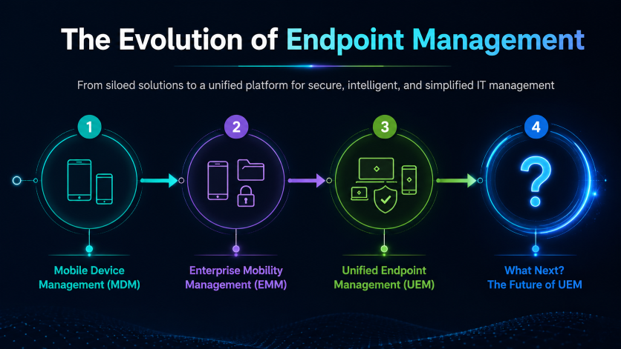
The Evolution of Endpoint Management

To address growing workplace complexity and security challenges, endpoint management has continuously evolved over the years.

Mobile Device Management (MDM)

As smartphones and tablets entered the enterprise, Mobile Device Management (MDM) emerged to address mobile security challenges through:

  • Device enrollment
  • Mobile policy enforcement
  • Remote wipe
  • Secure app management
  • Email and access control

However, MDM primarily focused on mobile devices and operated separately from desktop and server management, creating management silos.

Enterprise Mobility Management (EMM)

To improve mobile productivity and data security, organizations adopted Enterprise Mobility Management (EMM), which expanded capabilities through:

  • Mobile Application Management (MAM)
  • Mobile Content Management (MCM)
  • Identity and access management
  • Secure enterprise workspaces

While EMM improved mobile security and productivity, organizations still faced challenges managing desktops, IoT devices, and hybrid environments from a single platform.

Unified Endpoint Management (UEM)

Unified Endpoint Management (UEM) represents the convergence of endpoint management, mobility management, and security operations into a single intelligent platform.

Modern UEM platforms manage:

  • Laptops and desktops
  • Smartphones and tablets
  • Rugged devices
  • Kiosks and POS systems
  • IoT and industrial endpoints
  • Remote workforce environments

This evolution enables organizations to operate with greater agility, stronger security, and simplified IT administration across increasingly distributed environments.

What Next? The Future Beyond UEM

The modern digital workplace continues to evolve with hybrid work, cloud adoption, AI-driven operations, and increasingly sophisticated cyber threats. As enterprise environments become more distributed, organizations require a more unified approach that seamlessly integrates endpoint management, identity, security, compliance, and intelligent automation.

Recognizing these evolving enterprise requirements, halofort has developed Unified Endpoint Management Xtended (UEMX) platform for security-first organizations.

 HaloFort UEMX extends endpoint management by bringing together Unified Endpoint Management, identity-driven Zero Trust security, compliance management, and intelligent automation into a single intelligent platform.

Built for security-first organizations, HaloFort UEMX enables enterprises to:

  • Securely manage every endpoint
  • Verify every identity
  • Enforce Zero Trust access
  • Automate compliance
  • Strengthen endpoint security
  • Simplify IT operations
  • Gain centralized visibility and control
  • Support modern digital workplaces

Rather than managing devices alone, UEMX solution provides organizations with a unified platform to manage users, devices, applications, identities, and security policies through a single console.

Conclusion

The evolution from MDM to EMM and then to UEM reflects how enterprise endpoint management has continuously adapted to changing business needs and workplace technologies.

As organizations continue embracing hybrid work, cloud services, and increasingly distributed IT environments, endpoint management must evolve beyond managing devices to deliver a more connected, intelligent, and security-first approach.

halofort Unified Endpoint Management Xtended (UEMX) represents the next phase in endpoint management by bringing together endpoint management, identity driven Zero Trust security, compliance, and intelligent automation within a single unified platform. By providing centralized visibility, policy-driven governance, and integrated security, halofort UEMX helps organizations simplify IT operations, strengthen cyber resilience, and confidently manage the modern digital workplace.